
One more reason that people should be training parkour... The Aussies have been advocating the upcoming "zombie apocalypse" as a reason to train parkour for years and apparently the rest of the world is finally catching on.
Showing posts with label parkour. Show all posts
Showing posts with label parkour. Show all posts
Monday, October 29, 2012


Sunday, July 1, 2012
Life at Gerlev: Classes
A bit more background on the setup at Gerlev. The school year is made up of 3 semesters: September - December (17 weeks), January - February (8 weeks), March - June (17 weeks), and a summer break in which the campus hosts a full
schedule of seminars and workshops from July - August. The different semesters allow for a
wide variety in the sports that are offered (see here for the full list) but also creates a
key part of the financial backbone of the school. The Danish government subsidizes up to one third
of the operating expenses of the school, with another third that is paid by
the student’s tuition, and the final third that is covered by the use of the campus by a number of summer
events and workshops in addition to conferences throughout the year.
At 8, we all head to the main hall where we have the morning assembly. Since the morning assemblies that I had experienced previously in middle and high school in the US were not particularly positive (usually an obnoxiously cheerful voice reading semi-relevant announcements over the loudspeaker way too early in the morning) the assemblies here were a bit of a shock to me. First of all, each assembly starts with the entire staff and student body singing a song from the school hymnbook that each student is given when they arrive at school.


Most
of you who know me know that I am not particularly gifted at singing, and I
have found that I am even less gifted at singing in a language that I can
neither read nor speak. That being said, there is something remarkably uplifting and uniting about mumbling Danish songs alongside a room full of fellow students and staff each morning. I've also found that over the course of a few months I have started to grasp the semi-correct pronunciation of the words in the book, although I still have no idea what 99% of them mean.
After the song there is a 20-minute presentation by one of the staff members or students on a topic of thier choice. Some of the subjects this past semester covered the foundations of democracy, growing up in a foreign country, personal challenges and conflicts facing students, background on various pieces of artwork around the school, influential life experiences from students or staff, and a few life lessons from the wiser and more seasoned members of the teaching staff.

Games is actually “Tradition Danish Games” and is actually a 2-part course that takes place in the Gerlev Legepark (Gerlev Playpark) located next to the school. The first two months of the course were spent playing a lot of the games and learning about them, with a few instances when we were expected to lead the sessions ourselves. The secod half of the semester the focus has been entirely on the instruction of these games and how to use them to bring different groups together and develop certain skill sets in children. While a few of the games are very similar to the ones that I played as a kid, there a lot that were new to me and that I will definitely be taking back home with me.
Needless to say, I am only taking one load of courses at the
school so my schedule only reflects a small sampling of the options at the
school. For more information on the full range of activities available (there are a lot), check out the Gerlev website.
The 125+ students at Gerelv hail from all parts of Denmark with a fairly equal representation from the three parts of the country (Zealand, Funen, Jutland, and Bornholm). While the majority fall within the 19-22 year-old age range of young adults that have finished high school and are taking some time off to travel and "find themselves" before continuing their studies or seeking employment, there are quite a few students that are older than the average, yet still seeking some personal reflection time.
A typical day as a Gerlev student
A typical day for me starts at 7:20, as I crawl out of
bed, put on whatever clothes are close at hand (depending on the weather this
is either a sweatshirt and sweatpants, or a t-shirt and sweatpants- more on the
dress code here later) and then head down to breakfast, where I am greeted by this:
 |
| While this picture is actually of lunch (hence the awake faces), it shows the dining room atmosphere. Photo courtesy of Rafaela Cappai. |
 |
| Still half asleep, but smiling already. That's how I feel most mornings at Gerlev. Photo courtesy of Dennis Madsen |
At 8, we all head to the main hall where we have the morning assembly. Since the morning assemblies that I had experienced previously in middle and high school in the US were not particularly positive (usually an obnoxiously cheerful voice reading semi-relevant announcements over the loudspeaker way too early in the morning) the assemblies here were a bit of a shock to me. First of all, each assembly starts with the entire staff and student body singing a song from the school hymnbook that each student is given when they arrive at school.


 |
| Morning assembly. Photo courtesy of Rafaela Cappai. |
After the song there is a 20-minute presentation by one of the staff members or students on a topic of thier choice. Some of the subjects this past semester covered the foundations of democracy, growing up in a foreign country, personal challenges and conflicts facing students, background on various pieces of artwork around the school, influential life experiences from students or staff, and a few life lessons from the wiser and more seasoned members of the teaching staff.
Following the morning assembly are the four 90-minute
class periods that make up the main portion of the day. In between each class there is a break for
food, whether it's the mid-morning snack, lunch, or mid-afternoon snack. More details on the food later as a paragraph or two can't do it justice. Each student has a Speciality course in which they have 8-10 hours of instruction each week and which is essentially their "major" while at Gerlev. Students also choose a Sports Subject, which meets for 6 hours a week over a 2-month period. In addition to these, there are two Study Subjects, which meet for 3 hours/week and change after 2-months. Here is a copy of my schedule for the past 4 months:

The classes schedule is set up to to ensure that that students get a
maximum amount of instruction time, but it also groups the classes to
ensure that the instructors benefit from the scheduling. It took me a few weeks to realize but the
schedule is actually cleverly set up so that most of the instructors are actually
only needed on campus for a maximum of 4 days/week, allowing them time to
pursue other interests or classes, train in their discipline, and spend time with family (which do not always live on
campus), or run another business (like Mikkel and
Martin at Streetmovement). The schedule below gives a rough idea of my normal weekly
schedule:
Some explanation
about the classes mentioned in my schedule:
As one can see, I spend the majority of my
class hours in Parkour, but over the course of the week I spend a lot of time
in the other classes as well. Of course
the schedule doesn’t show the training sessions after classes finish, in the evenings, or on the
weekends (I know that it’s hard to
believe, but I spend a lot of my free time training, conditioning, or writing
about it) but it gives a general idea of how I spend my time.
The Streetdance (also includes "House for Dummies") class has been a lot of fun and the opportunity to do it here with real “classes” has been a great opportunity and allowed me to sample from a number of different styles including house dance, jacking, popping, locking, hip hop, in a setting that is condusive to beginners like myself. The second two months saw the creation of a performance group called "The Grind" in which a number of the students performed various pieces at Gerlev parties and events.
 |
| A beautiful day in the park. Photo courtesy of Lucas Ribeiro de Lima. |
The Streetdance (also includes "House for Dummies") class has been a lot of fun and the opportunity to do it here with real “classes” has been a great opportunity and allowed me to sample from a number of different styles including house dance, jacking, popping, locking, hip hop, in a setting that is condusive to beginners like myself. The second two months saw the creation of a performance group called "The Grind" in which a number of the students performed various pieces at Gerlev parties and events.
.jpg) |
| Taking advantage of nice weather to train outside with "The Grind", Gerlev's Streetdance performance group. Photo courtesy of Sutton Atkins. |
Games is actually “Tradition Danish Games” and is actually a 2-part course that takes place in the Gerlev Legepark (Gerlev Playpark) located next to the school. The first two months of the course were spent playing a lot of the games and learning about them, with a few instances when we were expected to lead the sessions ourselves. The secod half of the semester the focus has been entirely on the instruction of these games and how to use them to bring different groups together and develop certain skill sets in children. While a few of the games are very similar to the ones that I played as a kid, there a lot that were new to me and that I will definitely be taking back home with me.
Martin (from Streetmovement) taught this class
about Sports Massage, not the lovey-dovey sensual massage that
some might expect at a højskole.
Needless to say, although the massage sessions themselves were not the most relaxing experiences, especially when given by other parkour guys, they certainly helped to speed up recovery from the
training and I learned a lot of useful techniques.
Knife-making is pretty self-explanatory, we ordered blades
and blocks of wood from local sources and have spent the last few weeks designing,
shaping, sanding, gluing, and polishing our knives.
 |
| From this.... |
 |
| To something simirlar to this. |
The School Meeting has been an interesting experience for me as I think it shows a lot about the Danish culture. During the meetings the student body and staff discuss the happenings and highlights of the past week, discuss preparations for the upcoming weeks events and guests or visitors, and bring up any issues that warrant school-wide discussion. While at first this seemed like an impractical forum for discussing things that might only impact a small amount of the people at the meeting, over the past four months I've come to realize that these meetings do more than address the problem at hand. These meetings offer an opportunity for anyone to voice concerns, problems, or proposed changes in a setting that is both receptive and representative of the entire group. I was surprised to find that the issues presented were not resolved by a vote (which was described to me as a tyranny of the majority) but instead by the discussion of the issue until one side had gained the group's consensus. If all else fails, a committee is made to look into the issue further (Danes really seem to like forming committees, sub-committees, and committees to oversee the committees).
Club Sports is entirely organized by the students and offers many students the opportunity to try things that they can't cram into their schedule otherwise. There are the typical offerings (crossfit, circuit training, parkour, yoga, gymnastics, board games...) but each semester there are some sports that are unique to the interests of the students on campus like tree climbing, board games, and Vist (a danish card game). However, about halfway through the semester I decided that "club napping" was best for my physical health, especially since my increasing sleep debt was starting to hamper recovery.
The Joint Class changed each week and was basically a great excuse for all of the students to get together to participate in an activity. Different teachers and members of the staff led each week, so the themes were as varied and eclectic as thier interests and backgrounds, including swing dancing, cricket, group discussions, salsa, viking games, grinding, playpark events, hide-and-seek, Human Stratego, flashmobbing...
 |
| Despite the two sided setup that looks like opposing sides in a divorce case, these meetings actually help to keep the school working smoothly and cohesively. Photo courtesy of Rafaela Cappai. |
The Joint Class changed each week and was basically a great excuse for all of the students to get together to participate in an activity. Different teachers and members of the staff led each week, so the themes were as varied and eclectic as thier interests and backgrounds, including swing dancing, cricket, group discussions, salsa, viking games, grinding, playpark events, hide-and-seek, Human Stratego, flashmobbing...
 |
| "Flashmobbing" in downtown Slagelse. Photo courtesy of the Sealand News article covering the event. |
Sunday, April 1, 2012
An introduction to Bangkok
So after my visits to London and Paris had flown by, I
headed to Bangkok for the next part of my adventures. I arrived in the city and was welcomed by a sudden gust of hot humid air that hit me the moment the
airplane doors opened and forced me to take off the multiple layers that I had
been wearing. I was immediately struck by the “foreignness” of the city, which is very different from
the other places that I have visited over the past year and a half of traveling. While many aspects of life in Bangkok were
similar to things that I’d seen in other cities, there were a lot of things
that I had never seen before, and unlike most of the other places that I
visited, my “foreignness” couldn’t be hidden by keeping my mouth shut and
nodding and smiling, instead it was broadcast to all passerby's by my "Western" appearance.
The next day we spent the morning exploring the city before
heading over to Saphan Taksin to meet up with some local traceurs. The park that we met in was located under a major
highway overpass and had a number of basketball, football, and sepak takraw
(think volleyball + football) courts, a weightlifting area, and most
importantly, a metal climbing structure that looked like it had been built for
insanely heavy children, or just designed to stand for the next 200 years.
While the design of the structure may look pretty simple at first glance, the simplicity and unadorned design is perhaps the genius of it as a training structure as it allows for an almost infinite amount of creativity in movement. The park happens to be the preferred training spot of a group of young traceurs (aged 8-23) that call themselves the “Dark Monkeys”. While it still isn’t clear to me how much of their movement in the park is inspired by traceurs like Anan Anwar and the other members of Team Farang who have been using the park for the past few years and how much is totally organic (there seems to be a pretty incredible amount of “play” and “natural exploration” that goes on among the group, most of whom are between 10-16 years old), the routes and movements that they do show just how much time many of them spend there (it is almost guaranteed that 5-10 of them will be there any given afternoon after school lets out).
The first 2 minutes of the video below shows some footage that Leon took of movement at the park.
As one can see from the videos, the park offers seemingly limitless opportunities for creativity and expression. It was pretty amazing to watch the kids “playing” in the park as their movements seem to defy their ages in many cases and show just how much time many of them actually spend in the park. Training with the kids was a lot of fun and it soon became our “default” training spot throughout our time in Bangkok. While many of the traceurs had a high skill level when moving around the park, many aspects of “Parkour Generations/Yamakasi” training were pretty new to them, most notably many of the warm-up and conditioning drills. It was interesting to see how the kids had developed in the atmosphere of “play” which was very different from the atmosphere that exists in the Yamakasi and Parkour Generations training tradition. Many of the kids were very curious about the way we trained and even more so once shirts started coming off due to the heat and there was a a notable difference between the physiques of the two training methods (Leon was probably the most obvious example and his Hulk-like muscles were fascinating to the kids).
Within a few hours of arriving in Bangkok I met up with the
other members of the Parkour Generations family that had congregated in Thailand. While not all of the visits had been planned to overlap with the others, there were
way too many of us for it to be called a coincidence.
After spending an afternoon and evening getting re-adjusted to the
climate and the time change, we met up for a group training session at Lumpini
Park, conveniently located near the guest house some of us were staying at. The training group was an
international medley featuring Andy “Kiell” Day (UK), Violetta (Spain), Stephane
Vigroux (France), Leon Lawrence (UK), the Annty Marais (France), Bruno
Peixoto and his wife Rafa (Brazil), myself (USA), and some of the guys that
Steph had started training with from Bangkok. Anan Anwar (Thailand) and Shaun Wood (Australia)
also showed up to the park accompanied by Jason Paul (Germany), who was in town
to hang out with the guys and make some new videos with Team Farang (more
details to come). Since I’d been hearing
about these guys from various people throughout my travels it was good to
finally be able to train with them and see them move in person. Needless to say, we weren’t a particularly
small or inconspicuous group and we soon discovered that the Thai park
authorities were not nearly as understanding and accepting of parkour as their
British equivalents and we found ourselves moved on from one spot in the park
to another.
 |
| A PkGen family (+ extended family) reunion in Lumpini Park my first day in Thailand. Photo courtesy of Leon Lawrence. |
 |
| The park. |
 |
| Perhaps the demographic that it was initially intended for. |
While the design of the structure may look pretty simple at first glance, the simplicity and unadorned design is perhaps the genius of it as a training structure as it allows for an almost infinite amount of creativity in movement. The park happens to be the preferred training spot of a group of young traceurs (aged 8-23) that call themselves the “Dark Monkeys”. While it still isn’t clear to me how much of their movement in the park is inspired by traceurs like Anan Anwar and the other members of Team Farang who have been using the park for the past few years and how much is totally organic (there seems to be a pretty incredible amount of “play” and “natural exploration” that goes on among the group, most of whom are between 10-16 years old), the routes and movements that they do show just how much time many of them spend there (it is almost guaranteed that 5-10 of them will be there any given afternoon after school lets out).
The first 2 minutes of the video below shows some footage that Leon took of movement at the park.
As one can see from the videos, the park offers seemingly limitless opportunities for creativity and expression. It was pretty amazing to watch the kids “playing” in the park as their movements seem to defy their ages in many cases and show just how much time many of them actually spend in the park. Training with the kids was a lot of fun and it soon became our “default” training spot throughout our time in Bangkok. While many of the traceurs had a high skill level when moving around the park, many aspects of “Parkour Generations/Yamakasi” training were pretty new to them, most notably many of the warm-up and conditioning drills. It was interesting to see how the kids had developed in the atmosphere of “play” which was very different from the atmosphere that exists in the Yamakasi and Parkour Generations training tradition. Many of the kids were very curious about the way we trained and even more so once shirts started coming off due to the heat and there was a a notable difference between the physiques of the two training methods (Leon was probably the most obvious example and his Hulk-like muscles were fascinating to the kids).
 |
| Leading a"Parkour Generations style" warm-up at the park. Photo courtesy of Violetta Beral. |
Tuesday, February 21, 2012
East Coast Mini Road-trip: Greensboro, NC with TK17
After the afternoon spent photographing spots around Chapel
Hill Duncan and I drove to Greensboro to check out some of his favorite haunts
there. I’ve encountered very few people
during my travels that I’ve immediately felt a bond or connection with based on
our training styles but training with Duncan was a lot of fun. Greensboro turned out to have a number of
great places to train and we only ended up leaving when hunger and lack of
light persuaded us that it was time to go.


Duncan's video "Go" below is not only one of the better parkour videos that
I’ve seen, but it also gives some great views of the training spots around
Greensboro and UNC Chapel Hill that I had the opportunity to visit.
Friday, February 17, 2012
East Coast Mini Road-trip - American Parkour in DC
I spent the evening of my arrival in DC as well as my second full day in the city
with American Parkour (APK), based in central DC between the Truxton Circle and
NoMa neighborhoods. Over the course of my travels I’d heard a lot about
this organization, and learned about it’s impressive media and internet
presence. While I had mixed expectations
about what I’d find, I was excited to finally be able to meet the people behind
it all.
The building, a converted firehouse, was very different
from the other buildings I’d seen other parkour gyms hosted in, both because it
was built in 1895, and also because of the patchwork of improvement projects
and renovations that left it with the feel of part cross-fit gym, part jungle
gym, and part-little kid’s dream house.
The classes going on amid the perpetual hammering, sawing, and unpainted
surfaces meant that they didn’t have the same glossed and polished look that
other places I’ve visited had, but at the same time, it also felt like the gym
was never meant to have that look anyway, as there would always be things to
improve or tinker with. This feeling was
soon explained by my first encounter with the owner, Mark Toorock, aka M2, who
broke away from his POD (“project-of-the-day) of making longboard racks to hang
in the reception area to say hello and good-naturedly berate the interns on
duty, Tony and Tron*, who seemed more intent on bouncing around and
rough-housing than in running the front desk or helping with the facility
improvement.
Yeah, they like to flip a lot...
Knox - 2 Hours in a Birdman Shirt from Daniel Mannino on Vimeo.
My time at APK happened to overlap with visits by the
dynamic duo of Hamid and James, who had driven down from Michigan to hang out
with Travis, Levi, (Meeuwenberg, one of the first nationally-known American traceurs and well-known for his work
with Tempest Freerunning)
and Natalie, who was about to embark on a
cross-country parkour tour. The fact that it was a Friday leant a
particular flavor to the day’s proceedings, and after spending the afternoon
jumping around, things started to get wilder as evening fell.
My first impression of the Primal Fitness/American
Parkour building was of a bee-hive of organized chaos (which very different
from chaotic organization) as I walked in the big front door to find myself in
the midst of a cross-fit training session in full swing. Weaving my way through the room full of people
sweating and grunting as they pounded out their lunch hour WOD (workout of the
day) I made my way to the front desk.
After being greeted and signed in by the interns on staff I took a seat in
the corner to witness the daily routine of the gym as I waited to meet with
Mark and Travis.
 |
| APK and Primal Fitness World Headquarters. |
 |
| The reception area, whilst Tron and Tony were off flipping around. |
 |
| The "POD" - apparently longboarding isn't just unique to the Melbourne traceurs. |
*A quick note about
Tony and Tron. These two 16 year-old guys
are 2 of 6 “interns” that are part of the APK mentoring program in which the
participants work at the gym in return for free training time. Both the guys come from difficult backgrounds
in the inner-city, but they have embraced parkour wholeheartedly and have made
huge progress over the 2 years that they’ve been hanging out with the APK guys,
who have formed a sort of second family, complete with “family dinners” and “rules
of the house”. Talking to Mark about the
project was really interesting and the academic progress that the interns have
made (they have to maintain B’s to remain in the program) is yet more testament
to the power of sport, and specifically parkour, to change lives.
Yeah, they like to flip a lot...
While Mark was finishing his racks I got a chance to
explore the facility with Knox, who became my official tour guide for the
visit. The ground floor (or first floor
depending on which side of the pond you’re on) is home to the main training
area, which is used for the Primal Fitness crossfit classes and also for some
of the parkour classes. The space includes a lot of equipment for a
fairly small area, and is outfitted with a variety of pull-up bars, rings,
ropes, kettlebells, weights, vault boxes of various sizes, and even a “Ninja
Warrior Ladder” (seems like a trend…).
The second floor is divided between the offices of American
Parkour/Primal Fitness (the “World Headquarters of the APK” as I heard it
referred to) and a second training area. The “offices” include a lot of
computing power that is at the heart of the significant APK internet presence
especially in the USA. According to
Mark, the APK site is the most popular parkour site in the USA and has 70,000 -
100,000 visitors/month, and 11,000 people receive the daily “Parkour WOD” that
Travis sends out. While part of me
suspects that part of the credit should probably go to the clever naming of the
company to fit with web searches, Mark and his crew also deserve a lot of
credit for the work that they’ve done over the years (they have been involved
in the US parkour scene for a while now).
The office is where most of the preparations and logistical work for the
APK and The Tribe takes place (the media events company that includes many of
the APK members) and is also where many of their videos are produced.
(the APK YouTube Channel).
While all the fancy computer equipment can crank out a lot of work it
was good to see that on the Friday afternoon of my visit it was also put to use
to dominating the occasional online Tetris challenge (where I saw Tetris
brought to a level of skill and intensity far beyond “occasional gamer”).
The second training area was pretty cool and a large
amount of the space was dominated by a floor-to-ceiling scaffolding set-up.
Knox showed me around the scaf, and we spent a while messing around on it as I
have a particular affinity for anything resembling the playgrounds and
monkey-bars of my childhood. As he
essentially lives on the scaf, Knox had some really smooth “routines” worked
out which gave me plenty of things to work on during my visit. The space
also included a number of mats, vault boxes, and rails to allow for all sorts of
training and set-ups, as well as a number of window ledges and window frames
that made for some unique precision jumps and landings. The small hole in the ceiling you see in the video below is the entrance to the renovated 3rd floor/attic, which happens to be Mark's bedroom, which is one of the coolest bedrooms I've seen- sorry, no pics for Mark's sake (Mark assures me it's a great place to live, but he's had to get used to some extreme temperatures).
Knox - 2 Hours in a Birdman Shirt from Daniel Mannino on Vimeo.
After the afternoon’s activities simmered down a bit I
had a chance to talk to Mark and Travis (Graves) about their experiences and
perspectives on the development of parkour in DC, the growth of APK since its
inception in 2006, and a lot more information about the scene in general in the
US. This was really helpful for me since
they have both been involved with the sport for a while now and both are highly
regarded for their parkour skills or organizational prowess in many circles around
the world. By the end of my time in DC I was starting to feel that I had
a slightly better grasp on the development and current state of parkour in my
home country.
After a quick bite to eat at the local Safeway
supermarket (a key to any good parkour training spot’s long-term success- a
low-cost source for food that has a wide variety of foods, healthy and
otherwise) I headed back to the gym to join in the evening “parkour conditioning”
class, led by Rob (he led the whole class on one leg since he had broken the
other in a car accident shortly before). The class was good, although the
wide range in skill and fitness levels meant that I wasn’t as tired after the
class as I had become accustomed to in London. That being said, the class
included some exercises and equipment that I hadn’t seen featured in parkour
classes before, like the Prowler,
that were obviously a cross-over from the cross-fit classes and which I found
to be both effective and challenging (although they don’t work for traveling
light).
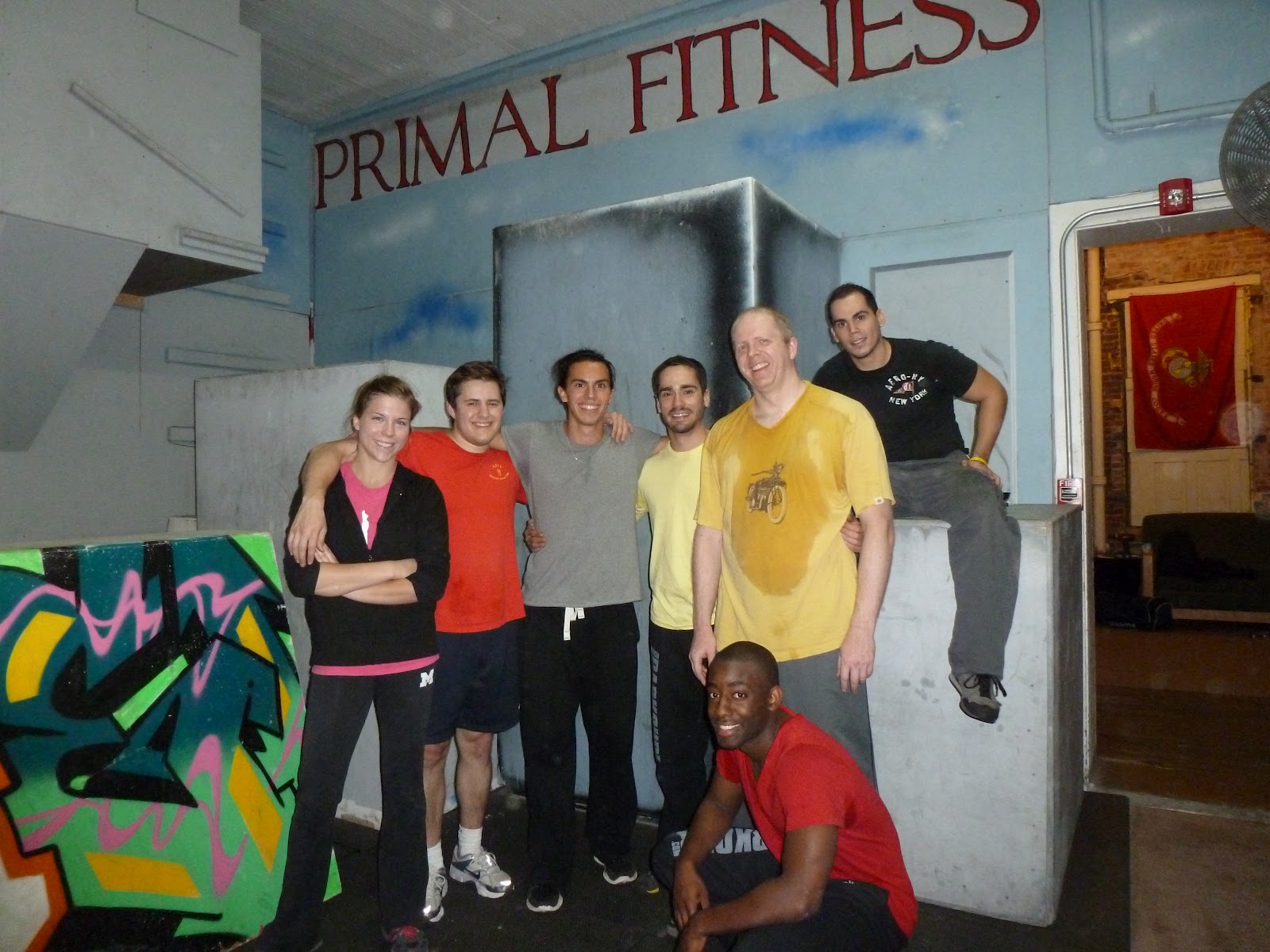 |
| After the class. |
After the official classes there was the Friday night
“Open Gym” which gave me my one of my only glimpses at the parkour community
that exists in the area. Unfortunately
both the class and the open gym that I attended didn’t have huge turnouts and I
wasn’t able to stick around for a normal “parkour training” class so I didn’t
get a chance to get a good feel for the APK community as a whole. Despite that, a number of people showed up
for Friday’s session and the resulting movement and games of “Add-on” (or “+1”)
were a lot of fun (especially since I finally managed to master a few of the
moves that I’d been working on over the past day and a half). As the
training only seemed to increase our energy levels, after the session we headed
out to explore the DC night scene, which turned out to be a fitting finale to my
visit to the city. However, I feel that
I was only able to see the tip of the iceberg concerning the parkour scene in
DC due to the briefness of my visit so I’m looking forward to a return visit.
 |
| Before people started showing up for the Open Gym. |
More information on American Parkour its extensive internet database or the classes they run in DC,
Gainesville, and San Antonio.
More information on PrimalFitness.
Wednesday, January 25, 2012
East Coash Mini Road-trip - Urban Evolution in DC
I spent my first full day in DC visiting the Urban Evolution gym and training with the guys there. The setup of the gym there was by far one of
the coolest ones that I’ve seen in my travels, from the brilliant graffiti that
adorned the walls to the sheer amount of “stuff” that was packed into the
gym. The set-up included a number of
elements that I hadn’t seen in other gyms, some of them, like the warped wall
or the “ladder” were easily recognizable from American Ninja Warrior, while
others, like the “floating platform” hanging from the ceiling in the middle of
the gym, seemed like something directly out of some little kid’s dreams of an
ideal play-space. I spent a lot of time
talking with Salil, the owner of the gym, about his company, his roots in the
DC parkour scene, and his plans for the future of Urban Evolution. It was really interesting to hear about the
growth of a parkour scene in my own country and I was surprised by how similar
it seemed to the stories I’d heard in other countries, despite my country’s
penchant for commercialist exploitation of just about anything.

While my experience over the past year and a half had prepared me for it, I have to admit that I was somewhat surprised to find that the “parkour politics” in the USA are just as lively and divided as they are in the other countries that I had visited. Similar to the situation in nearly every major metropolitan area that I’ve visited, DC has different “factions” that operate within the same city. However, I was happy to learn that unlike some cities I’ve visited, the grudges didn’t seem to extend past the original participants (as in nearly every case, the founding generation), and on the whole the DC parkour community seemed pretty cohesive. That being said, my visit only allowed me to scratch the surface of the scene there, so I’ll have to leave future observations for another time. I also didn’t have time to check out any of the outdoor spots in DC, which is probably my biggest regret from the trip, but inevitable since I was only spending two and a half days there. Guess I’ll just have to come back…

 |
| The view from the "floating" platform. |
 |
| The balance beam suspended 10 feet off the ground and attached to the floating platform. |
 |
| No gym is complete without lots of scaffolding. |
 |
| Ninja Warrior ladder at the left. |
I stayed at the gym for most of the day to get an idea of
the way things worked at the gym. This
allowed me to see some of the parkour classes that were run at the gym as well
as the other classes that were offered there like aerial arts, breakdance, and
jujitsu. One of the most appealing elements
of the gym was the versatility that it offered, with the capability to host
parkour jams, American Ninja Warrior contests, obstacles course challenges, circus
classes, breakdance jams, and all manner of other events- all while also
providing a safe and challenging place to train that could be manipulated and
changed to ensure that there were always fresh challenges.
 |
| The office- any place with that big a nerf arsenal is fine by me (either side of the door). |
While my experience over the past year and a half had prepared me for it, I have to admit that I was somewhat surprised to find that the “parkour politics” in the USA are just as lively and divided as they are in the other countries that I had visited. Similar to the situation in nearly every major metropolitan area that I’ve visited, DC has different “factions” that operate within the same city. However, I was happy to learn that unlike some cities I’ve visited, the grudges didn’t seem to extend past the original participants (as in nearly every case, the founding generation), and on the whole the DC parkour community seemed pretty cohesive. That being said, my visit only allowed me to scratch the surface of the scene there, so I’ll have to leave future observations for another time. I also didn’t have time to check out any of the outdoor spots in DC, which is probably my biggest regret from the trip, but inevitable since I was only spending two and a half days there. Guess I’ll just have to come back…
USA East Coast Mini-Roadtrip – Washington D.C.

Upon leaving Charlotte I headed north to Washington D.C. Since I hadn’t been to the nation’s capital
since I a school trip when I was 11, I did some preliminary research on the parkour scene in the city,
and found that there were a few groups in the region, two of which had set up parkour gyms in the DC metro
area. In order to check them both out
and to remain as objective as possible, I set up my visit so as
to be able to spend at least a day with each group.

Thursday, January 12, 2012
Early fall in London
After what seemed like far too little time in Paris I
returned to London, where the rest of my trip seemed to pass in a blur of
teaching and training. I had numerous
opportunities to build on my instructing experience, and since the London
community is so well established and welcoming, pretty much any time I was in
the mood for training there was at least one person, usually more, that were
willing to join me.
I spent the first few weeks of my stay bouncing around from
one person’s floor, couch, or guest bed to another, and found that although I
didn’t have much privacy or space to call my own, I didn’t miss it much nor
find it to be much of a sacrifice.
During the first few weeks in London I met a young filmmaker
who was putting together a documentary on parkour and asked to interview me for
the project. After the interview she came
with me to one of my favorite training spots to get some more footage of me interacting with
the urban environment. Below are some of
the still shots from the day.
All photos courtesy of Nadia Hammond.


Tuesday, November 1, 2011
Denmark: Background on Gerlev
Before I describe the events of my time in Gerlev, I should
give some background about the school. The
idea of the Folkehøjskole (translated from Danish as
“folk high school”) is one that dates back to the 1800’s and is Danish by
origin, although it has spread throughout most of the other Nordic countries as
well as Germany and Austria. It came initially
from the ideas of Nikolaj Grundtvig, a famous Danish philosopher and writer,
who took inspiration from both the English boarding school system and the
changes made to the French educational system after the French Revolution. However, instead of focusing on the
traditional “formal education” that we associate with schooling today, Grundtvig
focused on a more general education and enlightenment (somewhat akin to the “liberal
arts” education in American colleges/universities- not learning specific facts
and figures, but learning “how to think” instead). The folk high schools are designed to teach young
adults about enlightenment, morality, ethics, and democracy, but not in the way
that universities or schools typically approach this instruction. Instead, they teach these ideas through different
mediums such as sport, music, writing, or art.
Because there is no degree awarded at the end of the semester, the
schools have much more flexibility in their curriculums and the interactions
between students and staff are more open. While I will openly admit that I have
a bias for “gap-years” (I’ve done two of them now) the Danish tradition of
using the folk high school as a gap year to allow high school graduates or
university graduates to think about what they want to do with their lives seems
to be very mature, and has also shown distinctive positive results, with
students that had taken the year off having a much lower university dropout
rate than students who didn’t.
The structure itself is under
constant critique and renovation, and each summer the guys make an effort to
add something to the structure or the surrounding area, a tradition that has
ensured that the traceurs always have new challenges.
After finishing a semester at
Gerlev (or two), students often go on to further studies, or start working in
the “real world”. Each year a small
number of the most advanced and proficient members of the parkour and street
dance tracks are offered the opportunity to become members of the Gerlev
performance team, a group of highly-skilled performers that showcases the
school’s talent and regularly performs shows and spectacles for a variety of
the events. Although I didn’t get a
chance to see a performance in person, I did train a lot with the guys and saw
some of the videos of performances that they did recently during a “tour” in China
and at this past summer’s European Gathering.
The Gerlev Performance Team show at the 2010 European Gathering
The Gerlev Performance Team on tour in China
Today, Denmark boasts more than 70 of these folk high
schools/academies (in a country of 5 million inhabitants). The Gerlev Idrætshøjskole (Roughy
translated as the “Gerlev Physical Education and Sports Academy”) itself was founded in 1938 and is currently the only sports academy on the eastern
island of Zealand. The 125 students live
in dormitories on campus from 2 to 10 months, and unlike many of the other
institutions, staff members also live in houses on or near campus, which
creates a very family-like atmosphere.
This is augmented by the fact that much of the daily maintenance and
upkeep work around campus is performed by the students, who each serve a
certain amount of time on the cooking staff and cleaning crews throughout the
semester. While it may seem like a small
detail, the result is that there seems to be a much greater air of
responsibility (although this may because my comparison was often with my own
university experience, where we had free campus laundry, and a large cleaning
staff to clean up after the more spoiled and slovenly members of the student
body.) During the summer the campus is
occupied by a constant stream of summer conferences and events that pay for a
large part of the school’s operating costs throughout the year, allowing the
school to keep student’s tuitions low (made even lower by subsidies from the
Danish government.) After Denmark’s
involvement in the war in Afghanistan, the school has also initiated a pilot
project to re-integrate veterans returning from tours in Afghanistan into
society by spending time at Gerlev..
During my stay at Gerlev I had the
opportunity to interview the headmaster, Finn Berggren, who I discovered was
the primary reason for Streetmovement’s presence at Gerlev. Finn has a long history with the school, as he
has been both a student and a professor there, in addition to the headmaster
for the past 10 years. His interest in Streetmovement
began 6 years ago when he saw the guys competing on a TV show game show and was
immediately captivated by the young men’s’ movement. Finn has a strong gymnastic background, a
sport that is already very popular in Denmark, and has coached around the world
for the Danish National gymnastics team and with a number of other high-level
teams. After talking with a fellow
administrator at Gerlev, he invited the SM guys to come teach a “sports class”
at Gerlev. After the success of the
first semester, the classes began to grow, becoming one of the more popular
classes, and eventually replacing the “gymnastics” discipline, a move that was
designed to keep up with the changing times and popular interests, while
keeping many of the traditional values of rigorous gymnastic training (as
anyone that has trained with the SM guys can attest to). Today, the Streetmovement course is one of
the most popular one at Gerlev and attracts nearly 1/3 of the students (both
men and women).
After a few years of training on
buildings around the Gerlev campus, the Streetmovement guys asked Finn to build
them a specialized training facility, essentially a parkour playground, something
which had never been attempted at that point.
The result, after a lot of planning by Streetmovement and funding from
the school, was the Gerlev Parkour Park.
 |
| Photo courtesy of the Streetmovement site. |
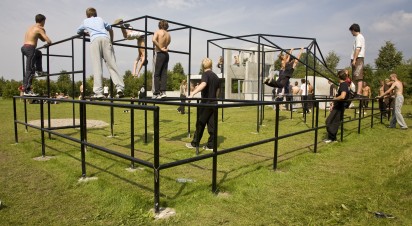 |
| Photo courtesy of the Streetmovement site. |
My time in Gerlev seemed to pass
in a blur of amazing food, lots of new friends, and a glimpse into a way of
life that is often very different from the one that I grew up with in the US. While of course the main focus of my time at
Gerlev was training with and learning from the Streetmovement instructors, the
fact that I was living in the dorms with the other students meant that I got
good look at life there.
The school’s primary focus is to give students the
opportunity to learn and develop important leadership and social skills that
are not always gained from the “typical adacemic experience”. The result is that there is as much of an emphasis
placed on the various aspects of social life at the school as on the actual
curriculum. Thus things like living
arrangements, taking responsibility as a group for the cleaning and upkeep of
the school, and helping prepare food for everyone are important parts of the
student’s lives. Each student is placed
in a “specialty track” which they follow for the course of the semester, with
10 hours of instruction per week in either in parkour, dance, football, or adventure
kayaking, beach volleyball, diving, circus arts, surfing, skiing, running, and
crossfit/fitness (some subjects are only available for a specific semester). The semester, which is 17 weeks in the spring
or fall and 6 weeks in the winter, also includes 6 lessons/week in an
under-study, which can be in house dance, swimming, gymnastics, street dance,
windsurfing, skating, martial arts, sports pedagogy, crossfit/fitness,
kayaking, dirt biking, beach volleyball, or parkour. And as if that wasn’t enough, students also
take 4 lessons/week in either philosophy, sports psychology, personal
development, music, event management, theater, band, body massage, drawing or
painting, or current debate.
 |
| The main grounds (Photo courtesy of Sk8Skool site.) |
Of course no description of life at Gerlev would be complete
without mentioning the amazing fare that is served at the school. My first introduction to the school
apparently passed like that of many others, as I was blown away by the
freshness and quantity of the food, and immediately stuffed myself with three
helpings of everything, realizing too late that I was about to train with the
Streetmovement guys right afterwards.
What makes the food so special?
Personally, I’m convinced that it is the combination of atmosphere,
presentation, source, and quantity that goes into it. The dining area is bright and open and the
four big tables at the center of the room from which the food is served, buffet
style, lend a very communal feeling to the meals. The food itself is mostly sourced from local
farms and include large quantities of seasonal items, in a presentation form
that is professional but not over-the-top.
And then of course, the quantity of food needed for 125 hungry and
active students, plus staff, gives the image of bounty that is appealing in and
of itself. The kitchen has the serving
down to a science, as it serves over 174,000 meals/year, and attracts a large
number of conferences and summer events based on the fare alone.
 |
| I know it's a stock photo but it shows the atmosphere of the kitchen. (Photo courtesy of the Gerlev site) |
The Gerlev Performance Team show at the 2010 European Gathering
The Gerlev Performance Team on tour in China
Friday, September 9, 2011
KRAP Parkour
So after a brief visit to Padova to have a bit of “vacation”
time with some close family friends and a day spent sightseeing at Venice (it
was cool, but not nearly as interesting as people make it out to be), I took the
train to Schio, Itlay, a few hours outside of Vincenza. I had met Giovanni and his brother Luigi at
the ECCE event in Rome and they had piqued my interest talking about a “park”
they had built. Although my schedule for
the rest of my time in Italy was pretty tight by then, I found a way to squeeze
in a flyby visit as I was en route to the Venetian airport for my flight to
Denmark.

Upon my arrival at the Schio train station in the late
morning, I was hit by a sudden wave of uncertainty that often accompanies
meeting new people and being in new environments. This wave was partly due to the fact that I
was still adjusting from an intense weekend with family friends in Padova, I
really wanted to get to Denmark where I’d be able to finally “settle down” for
a few weeks, and can also be attributed to the usual fatigue that comes with
constantly being on the move. From the train
platform, the town looked sleepy at best and very different from the bustling urban
centers that I had been exploring throughout most of the trip.
Most of these doubts were banished the moment that Giovanni
showed up and we drove back to his house to grab some lunch. After dropping my stuff off and inhaling some
food, we jogged over to the facility while his younger brother Luigi rode
alongside us on his bike “encouraging” us.
Any remaining doubts that I had were banished forever when
opened the front door of the “training facility”, called the Krapanonne. Once again the combination of lady luck and
my growing “parkour globetrotter instinct” had been proven right. Unfortunately my pictures from the visit are
lost in the abyss of electronics that is my failed digital camera so I don’t
have much to show for this section of the trip besides images I’ve taken from their site.
The facility is housed in a nondescript, industrial-looking building
with a small bright red door, set in the middle of a strip mall that seemed
semi-vacant. As Giovanni opened the
door, I caught a glimpse of the best indoor parkour training facility that I
had seen on the trip. Entering the
Krapanonne felt like entering into some surreal and impossible parkour paradise.
First of all the Krapanonne is HUGE. While I’ve seen a few warehouse/garage-based
parkour facilities, the Krapanonne’s building might be better described as a
small airplane hanger. Despite the Spartan
furnishings, it’s also very well lit, which seems to make feel even bigger and
more inviting. The simple fact that KRAP
has this much space to work with allows them a lot of flexibility in what they
do and how many things they can have going at the same time.
The second thing that struck me as I entered was the
“rawness” of the space. All of the
construction and renovation work had been done by the members of the
association, and the result is that most obstacles and set-ups look and feel
like they have been made by people that actually use them. This is also a distinctly unpolished feel to
the facility, a sharp contrast to the only other facility that I’d heard of
that might rival the Krapanonne, that of Tempest Freerunning (I haven’t been
there yet but am hoping to visit this fall). The result is that the space feels
like it’s in a constant state of change and evolution, as new sets and “toys”
are built in the workshop at the back of the building.
The center of the facility is dominated by a huge ramp and scaffolding
that border an enormous foam pit that looks like it could hide a small army, or
at least a large monster, beneath the surface.
The setup allows for a huge range of training environments, for parkour,
as well as skating, bmx, skateboarding….

In addition to the great training environment, the
Krapanonne also functions as the KRAP World Headquarters, and so is equipped
with a full kitchen, (with optional bar setup), viewing platform/raised reception
area, fully-equipped dance studio (used for children’s classes in dance, gymnastics,
and “movement”), a decked-out media lab, and some very Spartan living quarters.
The back of the facility is devoted to a workshop of sorts
that seems to be constantly spewing out all sorts of cool additions to the
Krapanonne. These can be useful- like
the skateboard racks that I watched being manufactured for a “store” being
built on the viewing deck, and “not quite so useful”- like the giant space-invader
figures that were built for the KRAP Invaders event (more on that later) but
now seem to materialize at most KRAP parkour events.
After ooo-ing and awing at the space for a while I took some
time to film one of the “Natural Movement” classes that KRAP offered to kids ages
3-8. The class was a lot of fun to watch
and I was reminded again about how similar kids are all over the world and how
naturally we resort to many of the movements that are at the foundation of
parkour. The guys explained to me that
the class was designed to teach all sorts of movement, including elements from
dance, gymnastics, parkour, and yoga in order to give the kids a basic
understanding and control of their bodies.
After being inspired by the kids in the afternoon I took some time
afterwards to play around on the scaffolding and foam pit and take advantage of
my amazing surroundings, despite an aching and tired body.
After resting up for a bit we prepared for the adult
parkour/freerunning class later that night.
As the official “gringo” and newcomer I was invited to lead the warm-up
for the class, and based on a lot of the reactions that I got mid-way through it,
I suspect that most of the people hadn’t been exposed to the same level of
conditioning that I’d gotten used to with Parkour Generations. That being said, the guys adapted well and
the rest of the class passed in a flurry of trying to observe everything while
also trying to participate to the maximum.
Once the class was over, I retired to the “lounge” where I
did an official “KRAP interview” about my travels. Apparently they interview all of the
foreigners that come to train with them, and I was told that at some point the
interview would be put on their Youtube channel, although the English-Italian
language barrier promised to make editing difficult. I also got a chance to do my own interview of
the management team, and learned a lot about the organization, how it started,
how it worked, and some of their future plans and ambitions. I left the session, which became more of a
friendly discussion by the end, in a daze around 1am, when I realized that I
had to be up and on a plane to Denmark a few hours later.
I’ll pass along the basics of what I learned, for more
information, and for some awesome videos, check out the KRAP YouTube channel. The “KRAP Assc.” was founded in 2008 with the
goal of giving youth in the area the opportunity to practice various freestyle
sports in a safe and constructive environment that emphasized the values at the
core of most of the sports. One of the
key benefits of the membership is that it provides insurance coverage for a
number of these sports, including parkour/freerunning, skateboarding, skating,
bmx biking, snowboarding, and juggling.
After the initial success of the KRAP classes and events, the
association started construction on the Krapanonne, which opened in 2010.
KRAP runs classes and workshops at the Krapanonne and
various hotspots around town for the various sports, and this year is also
hoping to start working with a number of schools in the area as well. In
addition to the educational side, KRAP also has a developing commercial branch,
and “sponsored” athletes are featured in a wide variety of media productions,
some of which are coordinated by members in the Krapanonne media lab (example). The KRAP calendar of events is pretty
impressive, and it seems like there is a constant bustle around the place as
various events are being planned and staged.
The most important parkour event, called “KRAP Invaders” is a multi day
event, that, among other things, features a one-day “invasion” of an Italian city
by a small army of traceurs that moves from spot to spot throughout the city
over the course of a day. The event also
features a day in Schio that includes jamming on a specifically built
scaffolding setup, as well as an afternoon “cliffdiving” in a local spot. The videos for these
events are pretty awesome in and of themselves, and feature an impressive roster of traceurs from around Europe...
KRAP INVADERS 1.0 (2010)
KRAP INVADERS 2.0 (2011)

KRAP INVADERS 1.0 (2010)
KRAP INVADERS 2.0 (2011)
A big thank you to Giovanni, Luigi, and Jessica for their amazingly warm welcome into the KRAP family.
Thursday, August 4, 2011
Rome – ECCE Parkour Event
After spending a great two weeks with Laurent and company in Milan I braved the Italian rail system and headed to Rome. While I’d expected chaos, I was pleasantly surprised to find that the rail system in Italy, like in France, seems to run with a different mindset than the rest of the country. The journey passed uneventfully and upon coming out of the train station I found myself in one of the coolest cities of the year. While a lot of the other cities that I’ve visited have had fascinating buildings, great museums, and interesting monuments, Rome brings all of this to the next level. There is something about the city that is immediately captivating, and I soon began relishing walking around corners, since I never knew what awaited me.
After figuring out how the Metro system worked (not the world’s best) I met up with the friend of my family that I’d be staying with during my time in Rome. The reason that I was in Rome wasn’t just because I’ve dreamed of visiting the city since I was a wee lad dreaming of legions and gladiators, but my visit also conveniently coincided with a workshop hosted by ECCE parkour that would be importing some of the Parkour Generations instructors to lead it. Having heard about it a few weeks earlier, I arranged my travel plans so as to be in town for the event, giving me a glimpse of Italian parkour and also getting the opportunity to finish up the last remaining ADAPT supervised instructional hours (I also added some days on to my stay after the event to do a bit of the tourist thing for once- more in the next post).

The next day I was up and battling the crowds of Romans that engage in a daily ritual that is startlingly reminiscent of the battles that raged in the streets of Rome about 2000 years ago. Rome only has 2 subway lines, and their sole overlap point also happens to be the central terminal for all the regional trains coming into the city (all roads and trains lead to Rome). This setup, combined with the passion that means that most voyages in the city will involve at least one episode of the hand-to-hand combat that is subway travel. The roads aren’t much different, as I soon learned from the friend that I was staying with, who had one car for the hand-to-hand combat of city travel, and another for traveling outside the city limits.
Upon arriving at the location for the event, I was shocked to find that it was located less than 50m from the walls of the Vatican, and hill that the Vatican sits upon rose up behind us and formed a beautiful background. After gaping at the setup, I headed over to reunite with Forrest, Chris, and Alli, who I had last seen in London a few weeks previously during my briefly stopover. Since I still had a few hours to complete from my ADAPT certification, I volunteered to lend a hand throughout the weekend, which led to me getting way more hours than I needed.
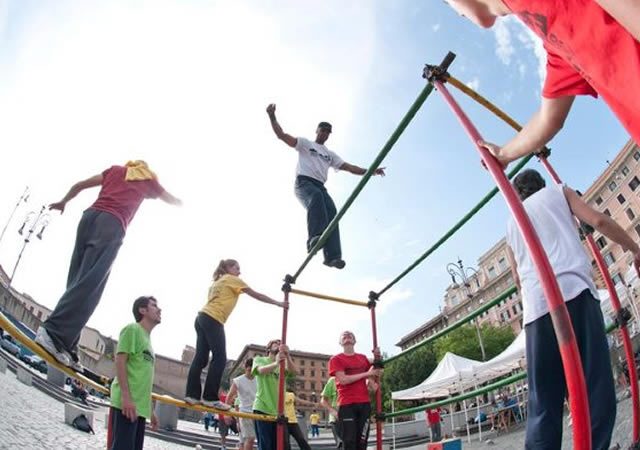 |
| Forrest atop some of the scaffolding set up for the event (the Vatican is in the background to the left). (Photo courtesy of Sophia Jeque) |
As we hung out and helped with the setup we watched the participants for the weekend start to filter in. The crowd was pretty diverse in terms of experience and skill levels (over this year I’ve learned that these are not necessarily connected), and there were a number of guys that were at a pretty high level. After delaying the start a bit to finish setting up and let the latecomers drop their stuff off, we set out for the warm-up. After spending 2 months in Brasil, where a group warm-up is usually about as organized as most events got, if that, the ECCE event was a nice change. The organizers had structured the event into a number of sessions each day, with breaks for lunch and snacks. Each of the sessions was to feature instruction or conditioning led by the PkGen instructors, or free time in which the participants could train on the equipment as desired.
In addition to organizing a very well-run event, ECCE parkour had also done a great job in choosing a location to host the event. Not only was the main location just outside the Vatican, but it was also within a short jog from Piazza San Pietro (St. Peter's Square) (where we attempted to do the first warm-up before being shooed out by the security), and also the San Angelo Castle, where we did warm-up and conditioning for the rest of the days.
 |
| The setting for the first warm-up. (Photo courtesy of Andrejs Surdjukovs) |
 |
| The setting for the rest of our warm-ups. (Photo courtesy of Andrejs Surdjukovs) |
Each day we started off the day with the typical Parkour Generations warm-up. For those that haven’t experienced it, the Parkour Generations warm-up (like the Yamakasi one that it’s based on) is designed to not only wake (and shock) the system into a high state of alertness, but also doubles as a mini conditioning session. I also found that the “exported version is cleverly designed to gauge the fitness levels of the participants at various workshops and seminars, which determines many of the drills and exercises throughout the rest of the event. Over the course of the event I had the opportunity to see how the Parkour Generations “workshop division” works from the inside and the huge amount of things that go on behind the scenes that most participants never notice. I also had the opportunity to lead a few of the training sessions and found that the more I did, the more my confidence rose and the more I enjoyed the teaching. By the end of the event I was definitely on a teaching high and realized that I was now not only in love with the sport, but also in teaching it.
Throughout the event I tried to mingle with the Italian traceurs as much as I could and try to get a grasp of their experiences with parkour. This was facilitated by the fact that instead of going back to my friend’s place each night I went to the local accommodations that had been set up by ECCE to accommodate the large numbers of traceurs that needed lodgings. While far from as comfortable (a sleeping bag on a mat on the cold stone floor of a church basement) or convenient (a 20min bus ride away, with showers available for a 1-hour window 15-minutes from the church) it was just as much fun and I found that it was a great chance to really get to know the guys. It was pretty funny to see the different “parkour event” experience levels that attended since some the more veteran guys brought good but compact sleeping mats and bags, while the “greener” ones brought everything but the kitchen sink. While my Italian wasn’t nearly good enough to allow for much conversation in the native tongue, I found that between their English and my Spanish we were able to communicate pretty well.
 |
| Our makeshift lounge while waiting for the showers. (Photo courtesy of Andrejs Surdjukovs) |
I found that despite the fact that the traceurs at the event hailed from all over Italy there was a dominance by the northern states, where apparently parkour seems to have caught on faster. I also found that like many European countries, parkour in Italy can probably best be described as in it’s “teenager” status, with pretty high skill levels and the basics of established teaching organizations, but still far from the standard being set in places like the UK (busy teaching schedules, full-time parkour instructors, international workshops, indoor/outdoor facilities…). However, I also got an invitation to visit another parkour organization a few weeks later when I passed through Padova en route to the Venice airport. Those adventures will be detailed in a future article…
 |
| A great group of guys... |
By the third day of the event people were definitely starting to show signs of the hard training that they’d been put through over the weekend. Despite this, everyone mustered their energy for a last technique session in the morning along with some light conditioning (we decided not to do a “beast” session after gauging energy levels). They even managed to take full advantage of the “free-time” that they had between the last organized training session and taking down the scaffolding. I left the event that night with a feeling that I had had a major breakthrough in my approach to parkour teaching and feeling very inspired about future plans. While I hadn’t quite decided what I wanted those to be, the thought of “taking the unexplored route” upon completion of my Watson year instead of heading right to grad school was beginning to grow in my head.
However, after 4 solid days of training I was ready for a bit of a break and a chance to really explore the city…
Subscribe to:
Posts (Atom)
.jpg)

 Posts
Posts

