Showing posts with label Denmark. Show all posts

Wednesday, October 10, 2012

Parkour Heaven???

There has been a lot of attention in the parkour world recently focused on the opening of the new parkour training facility that has recently been completed in Denmark.  As is typical of the training environments designed by Street Movement, the BGI facility, which has both indoor AND outdoor areas, a number of large foam pits, trampolines, an open gymnastics/tricking space, tons of scaffolding, and all manner of concrete shapes, seems to be by far the best parkour facility around.  For a while the only glimpses of this amazing facility available to those outside of Denmark was this teaser video:


However, over the last few weeks the facility has seen an official opening and a number of events have already been hosted there including the "Generation Parkour" event held at the end of September.  Featuring presentations by Mikkel Rugaard, Mikkel Thisen, Martin Kallesøe, Stephane Vigroux, Laurent Piemontesi,  Dan Edwardes, Julie Angel, and Eugene Minogue, the conference also included a number of foreign visitors and "parkour academics".

Image courtesy of Street Movement.

Since its opening, the facility has been featured in a number of other videos.  Including a feature on a Danish television story (it's in Danish but the shots show a lot), and a show-reel by the one-man-invasion himself, Alex Pownall.


Friday, June 29, 2012

Denmark and Gerlev Idrætshøjskole

Now that I have been in Denmark for more than three months I think that it’s about time that I start sharing  some of my experiences here and explain more about the amazing place that has become a home away from home.

One of my articles from last summer (here) gives some background on Gerlev Idrætshøjskole, and the Danish folk high school system, but now that I’ve been here for a few months instead of a few weeks I think an updated and elaborated article is appropriate.


To start with, “here” is Gerlev Idrætshøjskole, which is located 5km outside of Slagelse, a small town (although by Danish standards it's a "city") located about an hour from Copenhagen.

Gerlev Idrætshøjskole from above.  Photo courtesy of the lovely ladies at the Gerlev front office.

I first visited Gerlev last June as part of my Watson around-the-world trip to witness the parkour classes that Streetmovement has been running here since 2006 and to train on the structure that had been built in 2008, and is considered to be one of, if not the first "parkour park".  The two and a half weeks that I stayed here were a small taste of student life  at Gerlev and left me both inspired and curious to learn more from this model.  After making the decision to continue my parkour-related travels this year, I accepted the invitation Streetmovement guys and the headmaster, Finn, to enroll as a student in the spring semester.

Before I go more into depth about my personal experiences at the school, a bit of background on the concept of the “højskole” (often translated into English as the“folk high school”).  The højskole tradition exists in many of the Scandinavian countries although the ones in Denmark and Norway seems to have developed a unique model.  Denmark, a country with a population of 5.5 million people, has over 75 højskoles spread across the nation, and according to official statistics (that I got from staff on campus) there were 8,405 students that attended a højskole in the 2010-2011 school year.  While this number is smaller than it was 15 years ago, it has been steadily increasing over the past 5 years, especially as these institutions begin to take students from farther abroad than the typical Euro-zone exchanges (I supposed I’m a good example of this).  Højskole students range in age from 18 to their late 20's and are usually in the midst of deciding what they want to do next in life, whether this is to start further studies, seek employment, or travel for a period of time as many Danish youth seem want to do.  Each højskole typically has a specific area of focus, usually in the arts, music, writing, or sports, and the goal of the "højskole experience" is centered around the personal development and exploration of student's potential than the pursuit of a degree or factual knowledge.  While the lack of a degree may seem strange at first, it allows the style of education and instruction at the schools to be much less “structured” and exploratory, which creates a very unique atmosphere.

"Hygge time", a concept that seems to be very important in Scandanavian countries, but even more so in the højskole setting.  Photo courtesy of Lotte Møller.

During my stay here I’ve learned that the idea of “gap years” to prepare young people with the social skills necessary to become constructive members of society upon adulthood is not limited to students that have finished their high school education.  Denmark also has a large number of efterskoles, which are similar to højskoles but oriented toward younger students that are still finishing their high school education.  I had the opportunity to visit one of these efterskoles recently and it seemed to be very similar to the højskole model except with more structure and academic emphasis (they need to continue their education afterwards) and a lot more angsty teenagers.  While the idea of two years of “self exploration” may seem a bit extravagant to people outside of Denmark, when I think back to my first year of university I know that a number of my peers could have benefited from year or two to figure things out before entering the American college system (which is a much more expensive place to “figure things out”).

While not necessarily representative of the typical American college experience, "Animal House" highlights some of the ways that many American students get sidetracked "exploring" and "figuring things out" the first years away from home.

Founded in 1938, Gerlev Idrætshøjskole is one of the oldest in the country, yet it is considered to be one of the more progressive and pioneering schools in a system that is steeped in tradition, especially when it comes to sports.  Most sports højskoles offer traditional team sports such as football (real football, not the American kind), handball, and basketball in addition to outdoor activities and some type of dance.  Gerlev offers some of these activities, but stands out as the only højskole that offers parkour, and one of the few that offers the variety of dance styles that Gerlev does.  While offering parkour is impressive, the fact that parkour and streetdance were added to replace the traditional “danish gymnastics” course says a lot about the way that the school thinks (as far as I can understand "danish gymnastics" is essentially artistic gymnastics made for performance, and it is a HUGE institution in Denmark- DGI, the Danish Gymnastics National Organzation- has nearly 1.1 million members around the country).  Below is an example of danish gymnastics (the hip modern version) from the National Danish Performance Team followed by a video of the Gerlev Performance Team's 2012 show:


My personal motivation for coming to Gerlev was a combination of a desire to keep traveling and training, the realization that I had a once-in-a-lifetime opportunity to try this, a desire to spend more time with the Streetmovement organization to see how they teach and train- all mixed in with a large amount of curiosity about how this place functions, how it fits into the Danish culture and society, and what unexpected knowledge I could learn while here.

Tuesday, November 1, 2011

Denmark: Background on Gerlev

Before I describe the events of my time in Gerlev, I should give some background about the school.  The idea of the Folkehøjskole (translated from Danish as “folk high school”) is one that dates back to the 1800’s and is Danish by origin, although it has spread throughout most of the other Nordic countries as well as Germany and Austria.  It came initially from the ideas of Nikolaj Grundtvig, a famous Danish philosopher and writer, who took inspiration from both the English boarding school system and the changes made to the French educational system after the French Revolution.  However, instead of focusing on the traditional “formal education” that we associate with schooling today, Grundtvig focused on a more general education and enlightenment (somewhat akin to the “liberal arts” education in American colleges/universities- not learning specific facts and figures, but learning “how to think” instead).  The folk high schools are designed to teach young adults about enlightenment, morality, ethics, and democracy, but not in the way that universities or schools typically approach this instruction.  Instead, they teach these ideas through different mediums such as sport, music, writing, or art.  Because there is no degree awarded at the end of the semester, the schools have much more flexibility in their curriculums and the interactions between students and staff are more open. While I will openly admit that I have a bias for “gap-years” (I’ve done two of them now) the Danish tradition of using the folk high school as a gap year to allow high school graduates or university graduates to think about what they want to do with their lives seems to be very mature, and has also shown distinctive positive results, with students that had taken the year off having a much lower university dropout rate than students who didn’t.

Today, Denmark boasts more than 70 of these folk high schools/academies (in a country of 5 million inhabitants).  The Gerlev Idrætshøjskole (Roughy translated as the “Gerlev Physical Education and Sports Academy”) itself was founded in 1938 and is currently the only sports academy on the eastern island of Zealand.  The 125 students live in dormitories on campus from 2 to 10 months, and unlike many of the other institutions, staff members also live in houses on or near campus, which creates a very family-like atmosphere.  This is augmented by the fact that much of the daily maintenance and upkeep work around campus is performed by the students, who each serve a certain amount of time on the cooking staff and cleaning crews throughout the semester.  While it may seem like a small detail, the result is that there seems to be a much greater air of responsibility (although this may because my comparison was often with my own university experience, where we had free campus laundry, and a large cleaning staff to clean up after the more spoiled and slovenly members of the student body.)  During the summer the campus is occupied by a constant stream of summer conferences and events that pay for a large part of the school’s operating costs throughout the year, allowing the school to keep student’s tuitions low (made even lower by subsidies from the Danish government.)  After Denmark’s involvement in the war in Afghanistan, the school has also initiated a pilot project to re-integrate veterans returning from tours in Afghanistan into society by spending time at Gerlev.. 

During my stay at Gerlev I had the opportunity to interview the headmaster, Finn Berggren, who I discovered was the primary reason for Streetmovement’s presence at Gerlev.  Finn has a long history with the school, as he has been both a student and a professor there, in addition to the headmaster for the past 10 years.  His interest in Streetmovement began 6 years ago when he saw the guys competing on a TV show game show and was immediately captivated by the young men’s’ movement.  Finn has a strong gymnastic background, a sport that is already very popular in Denmark, and has coached around the world for the Danish National gymnastics team and with a number of other high-level teams.  After talking with a fellow administrator at Gerlev, he invited the SM guys to come teach a “sports class” at Gerlev.  After the success of the first semester, the classes began to grow, becoming one of the more popular classes, and eventually replacing the “gymnastics” discipline, a move that was designed to keep up with the changing times and popular interests, while keeping many of the traditional values of rigorous gymnastic training (as anyone that has trained with the SM guys can attest to).  Today, the Streetmovement course is one of the most popular one at Gerlev and attracts nearly 1/3 of the students (both men and women).

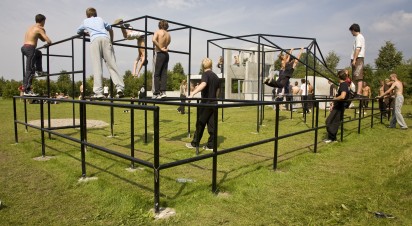
After a few years of training on buildings around the Gerlev campus, the Streetmovement guys asked Finn to build them a specialized training facility, essentially a parkour playground, something which had never been attempted at that point.  The result, after a lot of planning by Streetmovement and funding from the school, was the Gerlev Parkour Park.

Photo courtesy of the Streetmovement site.

Photo courtesy of the Streetmovement site.
The structure itself is under constant critique and renovation, and each summer the guys make an effort to add something to the structure or the surrounding area, a tradition that has ensured that the traceurs always have new challenges.

My time in Gerlev seemed to pass in a blur of amazing food, lots of new friends, and a glimpse into a way of life that is often very different from the one that I grew up with in the US.  While of course the main focus of my time at Gerlev was training with and learning from the Streetmovement instructors, the fact that I was living in the dorms with the other students meant that I got good look at life there.

The school’s primary focus is to give students the opportunity to learn and develop important leadership and social skills that are not always gained from the “typical adacemic experience”.  The result is that there is as much of an emphasis placed on the various aspects of social life at the school as on the actual curriculum.  Thus things like living arrangements, taking responsibility as a group for the cleaning and upkeep of the school, and helping prepare food for everyone are important parts of the student’s lives.  Each student is placed in a “specialty track” which they follow for the course of the semester, with 10 hours of instruction per week in either in parkour, dance, football, or adventure kayaking, beach volleyball, diving, circus arts, surfing, skiing, running, and crossfit/fitness (some subjects are only available for a specific semester).  The semester, which is 17 weeks in the spring or fall and 6 weeks in the winter, also includes 6 lessons/week in an under-study, which can be in house dance, swimming, gymnastics, street dance, windsurfing, skating, martial arts, sports pedagogy, crossfit/fitness, kayaking, dirt biking, beach volleyball, or parkour.  And as if that wasn’t enough, students also take 4 lessons/week in either philosophy, sports psychology, personal development, music, event management, theater, band, body massage, drawing or painting, or current debate.

The main grounds (Photo courtesy of Sk8Skool site.)
Of course no description of life at Gerlev would be complete without mentioning the amazing fare that is served at the school.  My first introduction to the school apparently passed like that of many others, as I was blown away by the freshness and quantity of the food, and immediately stuffed myself with three helpings of everything, realizing too late that I was about to train with the Streetmovement guys right afterwards.  What makes the food so special?  Personally, I’m convinced that it is the combination of atmosphere, presentation, source, and quantity that goes into it.  The dining area is bright and open and the four big tables at the center of the room from which the food is served, buffet style, lend a very communal feeling to the meals.  The food itself is mostly sourced from local farms and include large quantities of seasonal items, in a presentation form that is professional but not over-the-top.  And then of course, the quantity of food needed for 125 hungry and active students, plus staff, gives the image of bounty that is appealing in and of itself.  The kitchen has the serving down to a science, as it serves over 174,000 meals/year, and attracts a large number of conferences and summer events based on the fare alone. 

I know it's a stock photo but it shows the atmosphere of the kitchen. (Photo courtesy of the Gerlev site)
 After finishing a semester at Gerlev (or two), students often go on to further studies, or start working in the “real world”.  Each year a small number of the most advanced and proficient members of the parkour and street dance tracks are offered the opportunity to become members of the Gerlev performance team, a group of highly-skilled performers that showcases the school’s talent and regularly performs shows and spectacles for a variety of the events.  Although I didn’t get a chance to see a performance in person, I did train a lot with the guys and saw some of the videos of performances that they did recently during a “tour” in China and at this past summer’s European Gathering. 


The Gerlev Performance Team show at the 2010 European Gathering


The Gerlev Performance Team on tour in China

Wednesday, September 21, 2011

The first few days with Streetmovement in Denmark


 When my flight arrived in Denmark on a night in early June it was dark, cold (relative to Italy), wet, and raining.  Needless to say, as I stood on a street corner in downtown Copenhagen waiting to meet my contact I wasn't too excited about finding myself bundled in a jacket and a sweatshirt for the first time in 8 months.

However, things started to shift toward the better the moment that Martin arrived, and continued getting better and better over the two and a half weeks that I was in Denmark.  The next morning, we were up bright and early so that Martin could head to Streetmovement headquarters and the moment I stepped outside I realized that Denmark during the day wasn’t nearly as cold as it had been the night before.  As we stepped out into the street I noticed that Martin wasn’t wearing any shoes, but despite this, the people we passed only gave him a cursory glance as he jogged by (we only had one bike, so Martin had opted to run the first leg to the office).  This would be the first of many slightly quirky observations about the Danes that I would make during my time in Denmark, but the vast majority of them paint a slightly more optimistic picture for the future of humanity that the one that I’d gotten used to living in the US.

After a quick tour around the Streetmovement office, Martin showed me around the surrounding area.  The office is located in the part of downtown Copenhagen called “Carlsberg”, named for the fact that it was the site of Carlsberg Breweries until 2006, when the company moved all of its production and most of its infrastructure to another part of Denmark.  Since then, the area has been redeveloped for commercial use and 5 years later the results are pretty impressive.  Carlsberg is now home to a number of hip and “artsy” companies, and the building complex that the Streetmovment office is located in also hosts a number of architectural firms, designers, dance companies, artists, and theater groups. Pieces of “interactive artwork” are spread throughout the Carlsberg development and many of the pieces make for great training spots, especially since some of them were designed by the Streetmovement guys as part of a beautification project for the site.  One of them in particular, nicknamed “Rail Heaven” by the traceurs, is pictured below and definitely lives up to its name.

Rail Heaven.  Photo courtesy of Streetmovement. 

Photo courtesy of Streetmovement.
Another one of the "interactive artwork" pieces. Photo courtesy of Streetmovement.  
Photo courtesy of Streetmovement.
A bit more background and images of the Carlsberg site:


After spending the morning wandering the grounds while Martin had a meeting with one of the other Streetmovement directors, Mikkel “Hipster” (there are two Mikkels at Streetmovement, both are bald and very fit so I’ve included their nicknames for identification purposes), Martin and I headed back to his house to pick up some of the “Young Gunz” and head to Gerlev.  The Young Gunz are the “second generation” of Streetmovement guys, and as I was soon to discover, they are a lot of fun to hang out with in addition to being some of the most skilled practionners that I’ve met.  Packed into Martin’s small car with Thais, Oliver, and Andreas for the hour-long drive to Gerlev I found that the trip flew by in a blur of music sampling (both good and bad), a constant stream of banter, and me asking lots of questions about the Danish parkour scene.

A video of the Young Gunz a few years ago when the park was first built...


My first encounter with Gerlev was brief but made me realize just how lucky I was to have the opportunity to visit with the Streetmovement guys. We arrived at the school just in time for lunch, and upon entering the dining hall I realized why we had been so concerned about getting there in time for the midday meal.  The dining hall itself was bright, simple, and packed with more blonde hair that I’d seen in a while, but my attention was immediately arrested by the huge platters of food stretching, buffet style, down the center of the room.  Upon closer inspection I found that not only did the multicolor smorgasbord include everything needed in a healthy and balanced diet, but it was also completely composed of organic and locally grown produce. The result was a meal that had me coming back for thirds, with a brief interruption halfway through my second helping for my official “introduction” to the Gerlev student body (a slightly objectifying, but very welcoming experience).

After lunch I joined in the “Terrible Tuesday” afternoon conditioning session, which gave me the chance to begin getting to know some of the students at Gerlev, and also to train with another one of the Streetmovement directors, Mikkel aka “Babyface”.  The training session went really well and I got a good glimpse at the unique way of training that the Streetmovment athletes have developed.  This method seems to be a sort of hybrid that incorporates many of the Yamakasi’s values and basic conditioning techniques into a more modern and scientifically based training regimen, supplemented with a very sensible “Danish/Nordic” attitude toward proper nutrition and lifestyle.  After the session, which included lots of running, hills, squats, and quadrupedal movement, we headed back to the main hall for a quick “snack” (freshly baked bread, homemade jams, honey, and carrots) and then back out to the structure for the second afternoon session.  I spent the rest of the afternoon training with the Streetmovement class and getting to know the structure that I would be spending a lot of time on for the next two weeks.  At the end of the second session Martin took me on a brief tour of the rest of the facilities before we headed back to the dining hall for dinner (Note: this was the third meal since my arrival only a few hours before), which proved to be just as amazing as lunch.  After dinner Martin and I headed back to Copenhagen to pick up Brian, who was flying in the next morning from Parkour Generations to be a guest instructor at Streetcamp 7.

The Structure in all her glory right after construction a few years ago.  Photo courtesy of Streetmovement.   
The rails right next to the structure.  Photo courtesy of Streetmovement.
When we learned that Brian had missed his flight and would be coming Thursday morning instead we found that we had a lot of free time on our hands so Martin and I spent the morning catching up on sleep and hanging out at his apartment.  In the afternoon we went over to Street Mekka, a facility in downtown Copenhagen that opened in 2010 to offer “street based” leisure and sports activities to the youth of the city.  Street Mekka was created by a company called GAM3 and a large chunk of municipal funding for the restoration of an old warehouse in central Copenhagen into a vibrant and beautiful community center.  The facility offers classes and safe training environments for breakdancing, parkour, graffiti, dee-jaying, street basketball, street football, and hip hop dance throughout the week.  As the Streetmovment classes are an integral part of the “positive street culture” that Street Mekka is working to promote, a permanent parkour structure dominates the central courtyard area outside the building and Streetmovement classes are offered several times a week.

The entry to Street Mekka. Photo courtesy of Streetmovement.   
The main hall of the facility.  Photo courtesy of Streetmovement.
Children's classes at Street Mekka.  Photo courtesy of Streetmovement.
The adult Streetmovement class that I hopped into after a tour of the facilities proved to be just as well-run and challenging as the ones I’d seen in Gerlev, and like the classes I had seen at Pakour Generations in London, they seemed to cater to an older group of “working professionals” (both men and women) looking for alternative ways to keep fit, as well as the typical parkour demographic of boys aged 16-22. 

The adult Streetmovement class.  Photo courtesy of Streetmovement.
After the class Martin and I headed back to his place to grab some food and hang out a bit before heading to bed in order to pick up Brian the next morning and head straight to Gerlev for the start of Streetcamp 7…